

We are pleased to announce that the Dutch-Colombian architect and artist Roberto Uribe-Castro has been selected by an expert jury for the research residency at PACA.
After assessing the numerous proposals received, Roberto has been selected for his deep understanding of the complexity of the project, for his contribution to the lines of research, for the clarity of his presentation, for his trajectory as an experienced creator and for his flexibility. Using Eduardo Chillida’s notion of the horizon as a common homeland, Roberto will delve into the poignant history and current significance of the industrial port of El Musel and its open-air coal storage, as well as the different forms of resilience that have emerged.
We would like to thank all the artists and designers for submitting their proposals and for the enthusiasm they have shown us.
Roberto Uribe-Castro is a Dutch-Colombian architect and artist. He received the architecture degree from the Universidad de los Andes in Bogotá and his Masters in Fine Arts from the Weißensee School of Arts in Berlin. As a freelance architect he has done research work on Bogotá and the Sabana and he has been an external consultant for the first POT of Bogotá. As a designer he has worked in private residences in Amsterdam and Berlin. From Architecture Uribe-Castro was linked to large scale artistic projects working in research, production and assembly for Doris Salcedo («Untitled» at the Istanbul Biennial 2003 and «Shibboleth» at the Tate Modern in 2007) and Mona Hatoum («Silver Lining» in
Bern). The Master of Space Strategies in Berlin marks the beginning of his individual practice as an artist. His interest in the city, architecture and space as historical documents and archaeological sites leads him to take as a starting point either a specific site or an archetypal architectural space, seeking to establish a dialogue between architecture, politics and history through alterations or changes to existing elements. On other occasions Uribe works from urban elements such as billboards in ephemeral public installations that question lesser known histories of the chosen site. Roberto has been awarded the Berlin Senate research grant, finalist in several public space art competitions in Germany and Ireland, shortlisted for the EU competition Beyond Memorialisation. Uribe is co-founder and member of CC_Berlin NGO that works with communities in the development of projects to improve living conditions and decrease the vulnerability of rural communities in Mexico and Colombia.
https://robertouribecastro.de/en
Throughout my career, public space has been central to my work. I began as an architect in the studio of Colombian artist Doris Salcedo, where I developed projects deeply rooted in urban history, such as Untitled for the Istanbul Biennial in 2003. My experience as a field researcher for DAAPD in Bogotá further enriched my understanding of urban dynamics. Additionally, as an artist, I have curated public space projects like CALLE22 and have been a finalist in international competitions, including Beyond Memorialisation and various Kunst am Bau in Germany.
My current practice focuses on exploring ways of resilience, particularly how oppressed communities have found strength in the face of adversity. These communities and their territories have suffer in their own skin the consequences of an industrialisation base on the extraction and exploitation of resources. This aligns closely with the goals of the PACA residency, located in a region characterized by stark contrasts between heavily polluting industries and fragile rural spaces that still manage to fight for their existence. “The residency’s aim to explore the coexistence of these forces—economic development versus true sustainability—“ resonates deeply with my interests in architecture as with physical form of political oppression and the body as a vehicle for resistance.
For the PACA residency, I intend to investigate resilience on a small, sutil and fragile scale within this post-industrial context. I am particularly interested in examining the tension between nature and urban spaces in the context of the nearby industrial harbor of El Musel. Originally intended to create accessibility and foster a more connected relationship between communities and their fluid surroundings, harbors have today become the epitome of barriers and limits between waterfronts and locals, revealing the most perverse aspects of the privatization of our planet. I am committed to developing a project that not only captures the beauty of this territory but also highlights the urgent need for action to preserve our relationship with it.
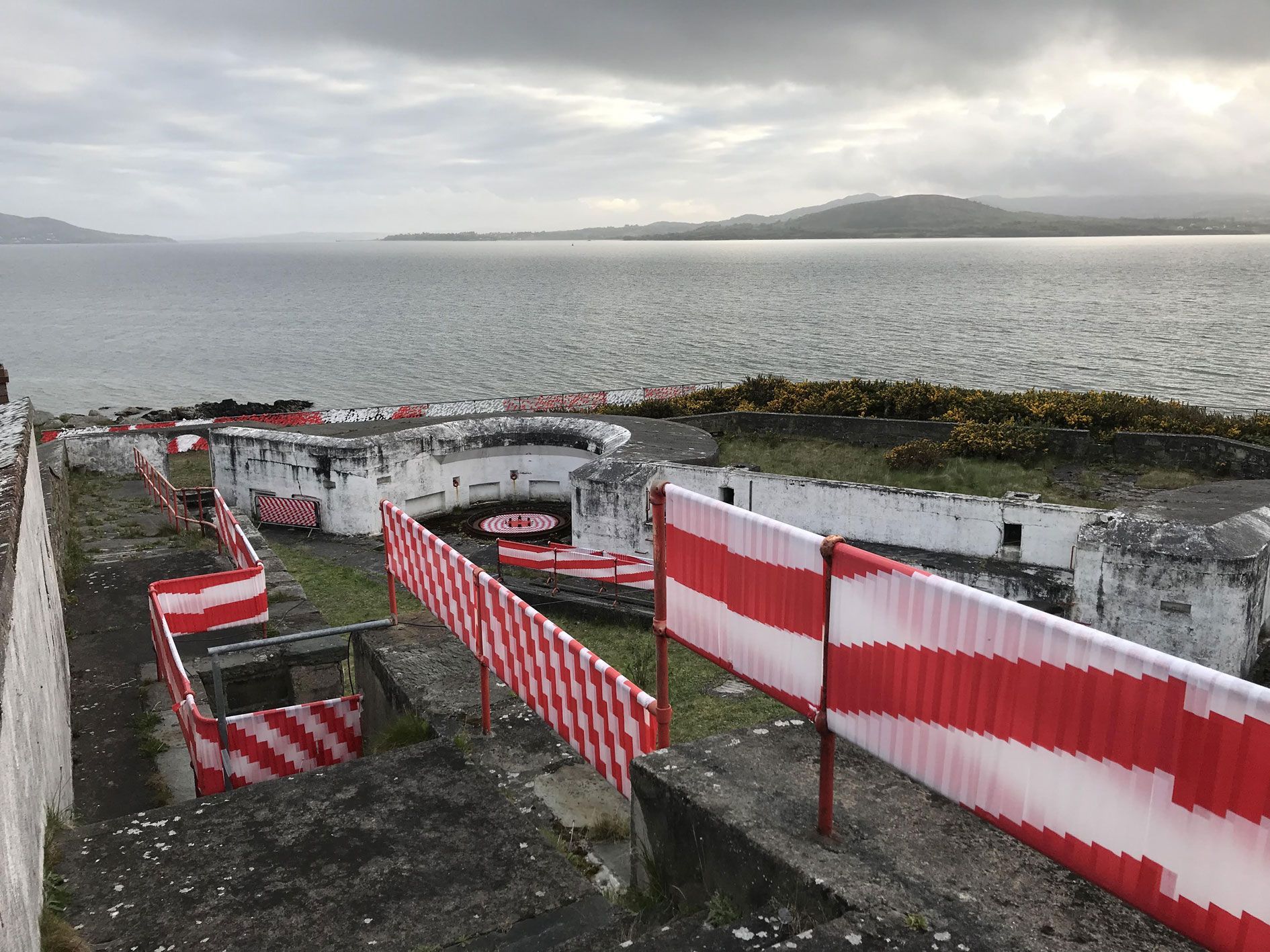
Art Link
Curated by: Adriana Valderrama, Rebecca Strain and Martha McCulloch
With: fotos by Jessica Auer and Roberto Uribe
Buncrana
2022
Roberto Uribe–Castro (1974) es arquitecto por la Universidad de los Andes en Bogotá y licenciado en Bellas Artes por la Weißensee School of Arts de Berlín. Ha trabajado como designer y arquitecto freelance en Amsterdam, Berlín y Bogotá. Ha colaborado en proyectos artísticos de gran escala trabajando en investigación, producción y montaje para Doris Salcedo ( «Untitled» en la Istanbul Biennial 2003 y «Shibboleth» enla Tate Modern, 2007) y Mona Hatoum («Silver Lining», Bern). El Máster de Estrategias Espaciales en Berlín marca el inicio de su práctica individual como artista. Su interés por la ciudad, la arquitectura y el espacio como documentos históricos y sitios arqueológicos lo lleva a tomar como punto de partida ya sea un lugar específico o un espacio arquitectónico arquetípico, buscando establecer un diálogo entre arquitectura, política e historia a través de alteraciones o cambios en elementos pre-existentes. En otras ocasiones Uribe trabaja a partir de elementos urbanos como vallas publicitarias, en instalaciones públicas efímeras que cuestionan historias menos conocidas del sitio elegido. Roberto ha sido galardonado con la beca de investigación del Senado de Berlín, finalista en varios concursos de arte y espacio público en Alemania e Irlanda, preseleccionado para el concurso de la UE Beyond Memorialisation. Uribe es cofundador y miembro de CC_Berlin, una ONG que trabaja con comunidades en el desarrollo de proyectos para mejorar las condiciones de vida y disminuir la vulnerabilidad de las comunidades rurales en México y Colombia.
https://robertouribecastro.de/en
El interés por el espacio público ha sido una constante en su trabajo, consciente del rol que el espacio público y la arquitectura juegan en la conformación de realidades sociales. A lo largo de su trayectoria como arquitecto y artista ha podido analizar cómo los eventos históricos, las decisiones políticas y las estructuras económicas contribuyen a marginar a determinados grupos sociales y étnicos, tanto en Colombia como a nivel global. Inició su carrera como arquitecto en el estudio de la artista colombiana Doris Salcedo, desarrollando proyectos profundamente enraizados en la historia urbana como Untitled para la Bienal de Estambul (2003). Su trabajo en la investigación de campo para DAAPD en Bogotá, enriqueció ulteriormente su comprensión de las dinámicas urbanas. Como artista, ha comisariado proyectos de intervenciones en el espacio público como CALLE 22 y ha sido finalista en premios internacionales como Beyond Memorialisation y varios Kunst am Bau en Alemania.
«Mi práctica artística se centra en explorar vías de resiliencia, en particular, cómo comunidades oprimidas han encontrado la fuerza para afrontar las adversidades. Estas comunidades y sus territorios han sufrido en la propia piel las consecuencias de una industrialización basada en la extracción y la explotación de sus recursos. Una línea de trabajo e interés que resuenan estrechamente con los objetivos planteados en la residencia en PACA, ubicada en una región caracterizada por los contrastes entre áreas industriales altamente contaminantes y zonas rurales frágiles que aún luchan por sobrevivir. “La residencia intenta explorar las posibilidades de coexistencia entre dos fuerzas, el posible desarrollo económico y una verdadera sostenibilidad” palabras que tienen mucho que ver con mi interés por la arquitectura en cuanto manifestación física de la opresión política y el cuerpo como vehículo de resistencia.
Durante la residencia en PACA intentaré investigar formas de resiliencia en pequeña escala al interno de este contexto post-industrial. Tengo especial interés en examinar y tomar como punto de partida la tensión naturaleza-espacio urbano en las zonas próximas al puerto industrial El Musel, desarrollando un proyecto que no solo capture la belleza de un paisaje sino que subraye la urgente necesidad de acción para poder preservar o restablecer nuestra relación con el territorio».
La residencia es un tiempo de investigación, de trabajo de campo, de contacto con el territorio, contextos locales procesos comunes. Por nuestra parte en PACA facilitaremos todo lo posible en esta fase: localizaciones, visitas, permisos, paseos, fuentes orales, entrevistas, consulta de documentos, trabajo de archivo, encuentros con artistas, investigadores, trabajadores, plataformas y colectivos, de manera que su mirada se nutra también con las miradas de quienes viven y han trabajado en este territorio. Nuevas miradas, intercambio de perspectivas, conocer y reconocerse, comprender, escucha y camino.
“What about post-industrial? The future of nature in co-existence with post-industrialized landscapes”.This three-week research residency at PACA (Asturias, Spain) is supported by the Dutch embassy in Spain. In collaboration with DutchInstitue and TransArtists.
#PostIndustrial open call focus on territory pdf
Jury : Virginia Lopez, artist and founder PACA_Proyectos Artísticos Casa Antonino @virginialopez_paca.artprojects/
Erik Wong & Sophie Krier. Co-curators of In search of the pluriverse (2020-ongoing, Nieuwe Instituut) https://nieuweinstituut.nl/en/projects/pluriverse @insearchofthepluriverse
Residency period at PACA: 3-week residency from the 26th of September till the 15th of October 2024.
